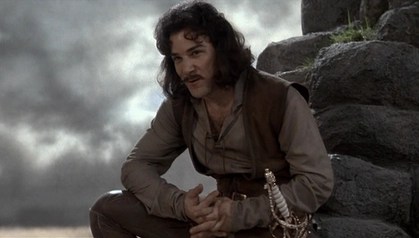
Inigo Montoya waits for a fight – By 20th Century Fox
Growing up with three brothers, I found my mother’s request to respect others sometimes felt meaningless. Ideas like, “Don’t say anything unless you have something nice to say,” felt as frustrating as not being allowed to put my elbows on the table. Putting on a veneer of politeness wasn’t something that interested me. Whether or not doing so was right, it sure wasn’t fun. But if that’s the version of politeness I understood, I missed something. Real respect isn’t for wimps, but for heroes, the type of behavior not divorced from maturity, but rather, unique to it.
Showing respect doesn’t cost the other person. It costs you. It’s easy to be mean. It’s easy to criticize. It is hard, however, to stand up for someone, especially when that someone is a person you don’t like. Martin Luther King Jr. chose to honor those whom it would have been easy to demonize. He said, “When evil men burn and bomb, good men must build and bind. When evil men shout ugly words of hatred, good men must commit themselves to the glories of love” (MLK Jr.).
In The Princess Bride, Inigo Montoya treats Pirate Roberts in a strange but beautiful way. He tosses him a rope, talks well of him, and even waits for him to catch his breath. Montoya even hands him his sword. When asked by Montoya if he is ready to fight, Pirate Roberts says, “Whether I am or not, you’ve been more than fair” (Princess Bride). When Pirate Roberts prevails and has the opportunity to run Montoya through, he says, “I would as soon destroy a stained-glass window as an artist like yourself” (Princess Bride). Even though Montoya lost the duel, his noble behavior mattered more than his defeat, and even paved the way for him to accomplish his greater objective later on.
Not everyone responds to respect the way Pirate Roberts does. But when people don’t take up the opportunity to return the honor, like Montoya’s arch enemy, Count Rugen, their actions only condemn themselves.
When was the last time you defended a politician you disliked, a hated group, a sleazy colleague, or for that matter, your own spouse, not because you were happy with what that person was doing, but because you wanted to treat them in the same kind of way you would hope they would have been acting? I am not suggesting we defend bad behavior. I am suggesting we show respect to all people, regardless of their behavior. Bad people need help, not criticism.
Consider William Wilberforce, who couldn’t change Parliament by himself. He brought in others, even those he might not have initially aligned with. He took blame and defended others while unequivocally condemning evil. “I mean not to accuse any one, but to take the shame upon myself… We are all guilty—we ought all to plead guilty, and not to exculpate ourselves by throwing the blame on others; and I therefore deprecate every kind of reflection against the various descriptions of people who are more immediately involved in this wretched business” (Wilberforce).
Respecting people we don’t appreciate takes courage and requires us to accept insults, but choosing to respond respectfully shows by our own behavior that there is a better way.
One such example comes from Les Misérables. The protagonist, Val Jean (M. Madeleine), who was himself shown honor by someone he showed evil, has a no-hesitation response of forgiving one of his beneficiaries. The police chief, Javert, is absolutely stupefied. Hugo writes,“[She] burst out laughing and spit in his [M. Madeleine’s] face. M. Madeleine wiped his face and said, ‘Inspector Javert, set this woman free.’ Javert felt as though he were about to lose his mind. At that moment he experienced . . . the most violent emotions he had known in his life. To see a prostitute spit in the face of a mayor was so monstrous that, in his wildest conjecture, even to imagine it would have seemed sacrilege.”
Are we, like Javert, unable to fathom how we could respect a person capable of such seamingless hideous action? Or are we, like Val Jean, able to brush it off? The reality is, true honor transcends how we are treated. We can only take insult properly when we know our true value apart from it. Val Jean’s choice to show respect even to those who acted badly transformed lives positively. Criticism doesn’t have the same effect.
People that choose to respect might seem rare, but if we start telling their stories, they might not be as rare as we think.
The leaders who are heckled and deflect disgrace with healthy humor.
The parents who are chewed out by the ones they’ve given their lives to and respond with gentleness.
The spouses who still serve tirelessly when they are fed criticism for their efforts.
The way of respect may seem lonely, but when we choose it, we are in great company.
Historically, soldiers have chosen to bury their enemies. Losers in political races have been included in serving with the victors. Rulers have added their conquered foes to their royal dinners.
Most of the time, however, we aren’t even dealing with people who are trying to actually hurt us. We’re not usually talking about dying for our choices. These people aren’t actual enemies. They’re just people we don’t like or whose perspective happens to disagree with ours. So the question is not about how we treat our enemies. The question is, how do we treat people?
All humans are worthy of respect. All. People might be acting so terribly they have themselves forgotten this is true. Let’s take their forgetfulness as an opportunity to remind them.
Life isn’t all rosy. The honorable person doesn’t always get laurels. Often the respectful person is shoved in the dirt and faces death at a tyrant’s hands. If tyrants are acting one way, we need to act differently. Martin Luther King Jr. also said, “He (Jesus) knew that the old eye-for-eye philosophy would leave everyone blind. He did not seek to overcome evil with evil. He overcame evil with good. Although crucified by hate, he responded with aggressive love.” To show respect in the face of opposition is a type of victory, but the reality is, winners of this definition often die.
So why is respect worth it? Even if it hurts?
Although Montoya may have twisted in revenge with his definition of respect, we can still learn from him. Before killing his father’s murderer, Montoya asks him to offer him power, money, and then, “Offer me everything I ask for!” The man does. Montoya wants none of it. Like for Montoya, what matters is beyond all of the glamor. Beyond our own lives. It is something that allows us to be knocked off our horses, covered in mud, and still wipe the spit off our faces with a good attitude. When we have matured, when we have experienced and embraced something worth more than all of the hate, something worth more than death, well, respect is the only real option.
References:
Inigo Montoya waits for a fight – By 20th Century Fox – https://princessbride.fandom.com/wiki/Inigo_Montoya, Fair use, https://en.wikipedia.org/w/index.php?curid=74817110
Martin Luther King, Jr.. (n.d.). AZQuotes.com. Retrieved October, 2025, from AZQuotes.com Web site: https://www.azquotes.com/quote/536003
Reiner, R (1987). The Princess Bride. Twentieth Century Fox. Script from https://courses.cs.washington.edu/courses/cse154/13su/exams/resources/The_Princess_Bride.html)
William Wilberforce. AZQuotes.com, Wind and Fly LTD, 2025. https://www.azquotes.com/author/15635-William_Wilberforce, accessed October, 2025
Hugo, Victor. Les Miserables (Les Misérables) 1862. (p. 192). (Function). Kindle Edition.
 Thetradingpost
Leave a comment